Next industrial revolution
Recently as part of the Chinese lunar new year celebration there was a showcase of there was a showcase of humanoid robots performing complex, coordinated Kung Fu movements—something that was not feasible even a year ago due to limitations in control, simulation fidelity, and edge inference. This clearly marks the brewing of a new industrial revolution. In this article we will take a look at the key components of such a Robot’s stack, which are also referred to as Physical AI, and its safety components.
These AI powered intelligent robots that can perceive, reason, and act at low latency in physical environments require a fundamentally different systems approach than cloud-based or offline AI.
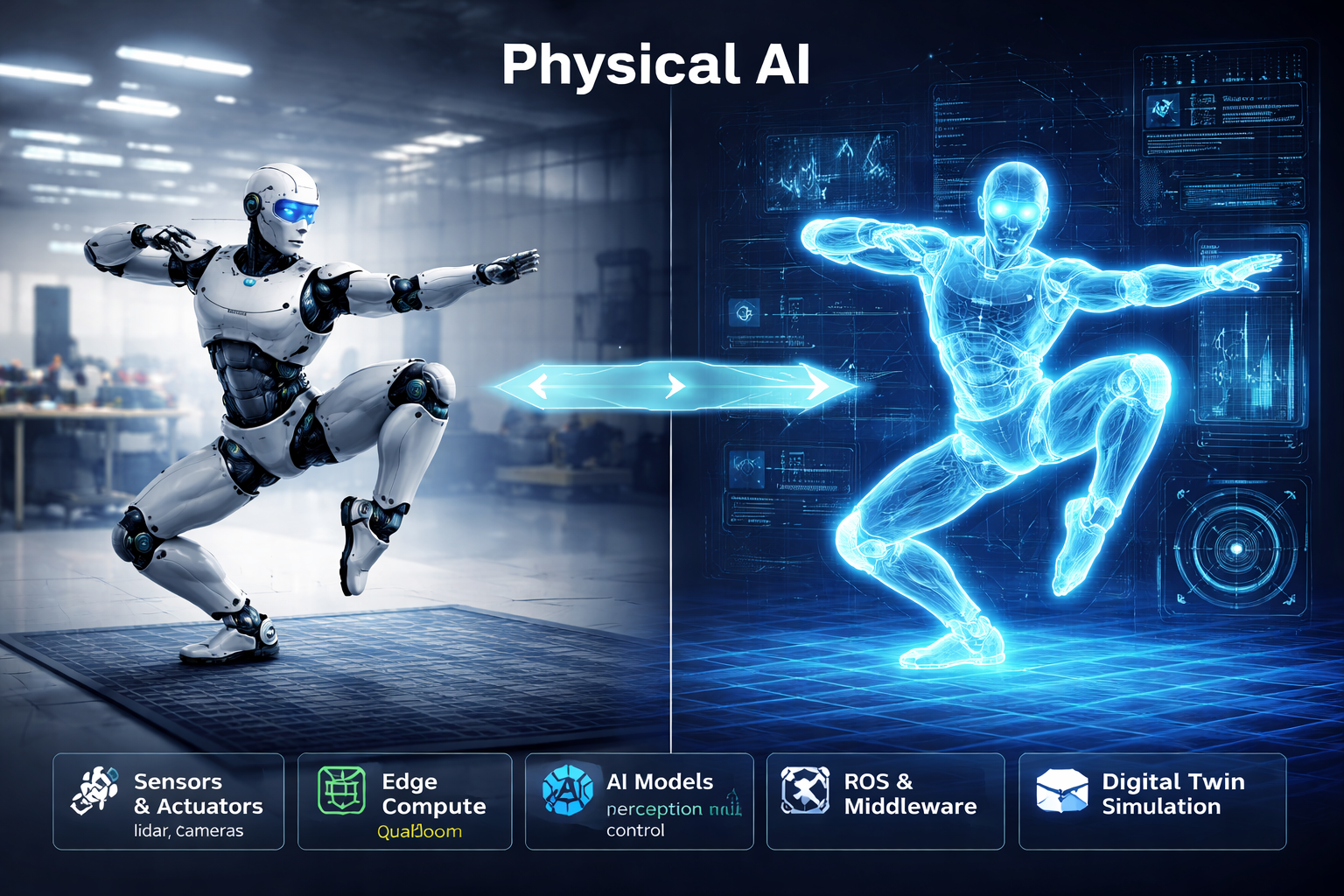
The key components of Robotic AI include:
Hardware - Sensors (Lidar, cameras), actuators, controllers.
Edge compute - on-device AI like NVIDIA Jetson and Qualcomm Dragonwing. Unlike conventional AI stacks, Physical AI systems must respect strict latency, determinism, and safety constraints—where milliseconds and actuator limits matter.
OS ROS - Robotic Operating System to handle the hardware abstraction, scheduling, and communications protocol.
Digital twins - Virtual environments like NVIDIA Omniverse simulate scenarios and Isaac sim to generate synthetic data, to test or train the AI models of the Robot.
AI models - The brains of the Robot - distilled and compressed for edge computation.
Application layer - Interface for human monitoring and integration to other systems.
Digital twin use in Robotics is particularly important. It provides a physics accurate virtual lab to bypass the data bottleneck of physical world, where things can be slow, expensive, or outright dangerous.
These provide high fidelity Physics engines, scene randomization for real world messy situations, and GPU clusters to enable much faster practice as compared to real world.
This creates a powerful flywheel: ambiguous or failure scenarios observed in the real world are fed back into the cloud, reconstructed in simulation, and used to retrain models—ensuring the system does not fail the same way twice.
Development best practices
- Developers should start with a Digital twin setup using Unified Robotic Description format or URDF to create a virtual replica of the physical space. This can also be used to do safety checks like a Robot dog crashing into a wall, or a humanoid robot tossing away a cat on table in attempt to declutter the table!
- Set the thresholds in the middleware bridge such as ROS python/C++ interacting with low-level motor controllers. For example, leg cannot swing more than X degrees per second.
- Deploy low-latency optimized AI models for edge intelligence.
- Do physical testing using tethered robot, fenced to “playpen”, and then free range robot with human-in-the-loop observer.
Responsible AI angle
- Mechanical failsafes for safety - implement Software watchdog for example to sit down robotic dogs. This could also include “kill switch” to E-stop the operations.
- Assume all data is sensitive by default as Robot may be doing 360 degree surveillance. So mimimize data, and only send metadata to cloud.
- Check for bias and sensor diversity. For example, sensors should have no bias for floor types.
- Log reasons for movement as this gives transparency and explanation for audits.
- Validate simulation-to-reality gaps and coverage to minimize surprises in production.
- Measure how often you hit the E-stop in simulations and controlled testing, production.
- Do regression testing for every model update.
- Use tools like Foxglove to see what the Robot sees; this is observability for the Robot AI stack!
Summary
Physical AI is forcing a convergence of robotics, real-time systems, simulation, and responsible AI practices. Architects who understand this full stack—not just models—will play a decisive role in shaping how safely and effectively this revolution unfolds.