As Agentic AI applications transition from experimental prototypes to production scale, finance and engineering teams are colliding over a new reality: the cost of autonomous operations. This has given rise to the concept of Tokenomics—the microeconomics of autonomous AI execution. Unlike traditional Generative AI applications where a user inputs a single prompt and receives a single response, autonomous agents operate in multi-step loops. They call external tools, reflect on failures, coordinate with other agents, and iteratively refine their outputs. This structural shift requires system architectures to be built with financial discipline, ensuring that autonomous loops generate more value than they consume.
The “context snowball”
In a standard chatbot workflow, token consumption is largely linear. You pay for what you input and what the model outputs. Agentic workflows, however, can consume orders of magnitude more tokens than traditional prompt-response applications. As agents plan, execute, reflect, and retry, they repeatedly re-ingest system instructions, conversation history, tool outputs, and the original objective. This creates a compounding “snowball” effect, where the same foundational context is charged repeatedly across dozens of iterations. What begins as a simple task can quickly evolve into a costly chain of reasoning cycles, tool invocations, and context expansion.
Unbounded Loop Vulnerability
The greatest operational risk in agentic architecture is the infinite loop.
If an agent lacks explicit exit conditions, a minor semantic misunderstanding or an unhandled edge case can trap it in a self-destructive cycle. The agent continues calling LLM APIs, invoking tools, and generating new context while accumulating cost with every iteration. In large-scale deployments, this can result in significant financial exposure long before a human operator notices the anomaly.
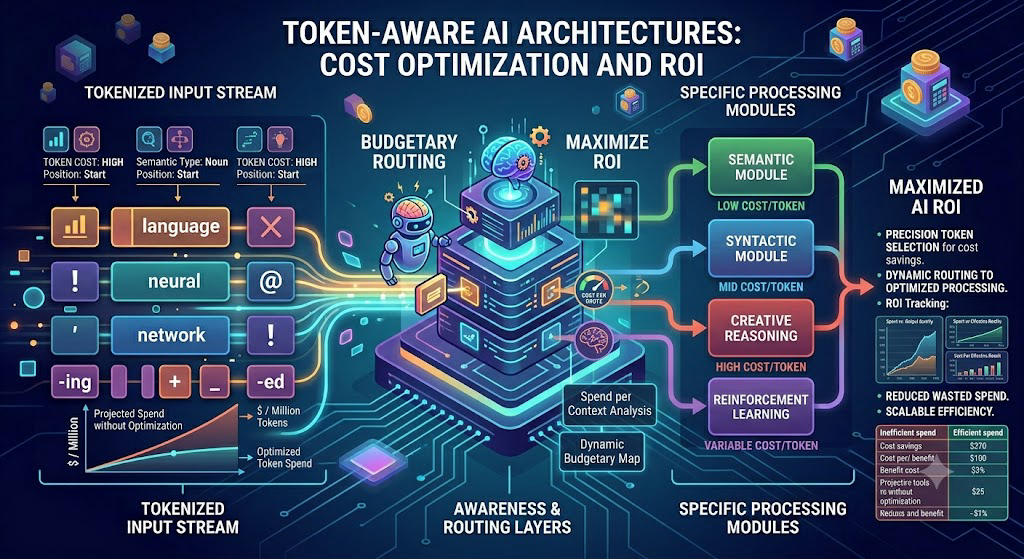
To prevent this financial “sticker shock,” developers must implement token-aware architectures:
Mandatory Reflection Ceilings: Define hard limits on the maximum number of reasoning cycles, tool invocations, or retries allowed per task. When limits are reached, gracefully degrade and escalate to a human-in-the-loop (HITL) for intervention.
Context Pruning and Dynamic Summarization: Avoid sending raw, ever-growing history back to the model. Use lightweight models to periodically compress, summarize, or discard intermediate reasoning artifacts before reintroducing context.
Model Cascading and Tiered Routing: Do not use your most expensive reasoning model to check a calendar or format JSON. Route deterministic tasks to smaller, specialized models and reserve frontier models for high-value reasoning.
Budget-Aware Execution: Treat token budgets as first-class architectural constraints. Agents should continuously evaluate whether the expected value of another iteration justifies its incremental cost.
Tokenomics beyond tokens
While token spend remains the most visible cost component, it is rarely the only one.
Every autonomous workflow may also incur costs through API calls, vector retrieval, observability platforms, orchestration frameworks, human review processes, and downstream compute services. As agentic systems mature, tokenomics evolves beyond LLM inference into the broader economics of autonomous execution.
Organizations that focus solely on token consumption risk optimizing the wrong variable. The true objective is maximizing business value while minimizing the total cost of completing a task.
The Emerging KPI: Cost Per Successful Outcome
Traditional AI deployments often focus on metrics such as token usage, latency, and model accuracy.
Agentic systems require a different lens.
A workflow that consumes ten times more tokens but eliminates several hours of manual effort may still deliver superior economics. Conversely, a low-cost agent that repeatedly fails and requires human intervention can become far more expensive in practice.
The metric that ultimately matters is Cost Per Successful Outcome.
As enterprises scale autonomous systems, success will increasingly be measured by how efficiently an agent converts dollars spent into business outcomes delivered. The goal is not minimizing token consumption; it is maximizing value created per dollar invested.
The Rise of Machine-to-Machine Commerce
As agents evolve from task executors into economic actors capable of purchasing data, APIs, compute resources, and specialized services from other agents, traditional payment infrastructure begins to show its limitations.
A 25-cent transaction fee makes a 2-cent data purchase economically irrational.
This friction is driving exploration of alternative settlement mechanisms, ranging from crypto-native payment rails and programmable wallets to enterprise agent marketplaces and prepaid API ecosystems. The common objective is reducing transaction overhead to a level where autonomous machine-to-machine (M2M) commerce becomes economically viable.
Whichever model ultimately prevails, the ability for agents to autonomously procure and consume services will become a foundational building block of future digital ecosystems.
Summary: The Next Frontier of AI ROI
The success of the enterprise AI revolution will not be determined solely by the intelligence of models, but by the efficiency of their execution.
We are entering an era of FinOps for AI, where software architecture is increasingly intertwined with cost engineering. Autonomous systems must be designed not only for accuracy and capability, but also for economic sustainability.
Organizations that fail to master tokenomics risk watching margins evaporate through autonomous overhead. Those that embrace token-aware architectures, outcome-driven measurement, and efficient machine-to-machine commerce will build highly scalable agentic ecosystems capable of delivering compounding returns.
The future belongs not to those who build the smartest agents, but to those who can make autonomy affordable.